Important context before any of this: it's rumour and reporting, not an announcement
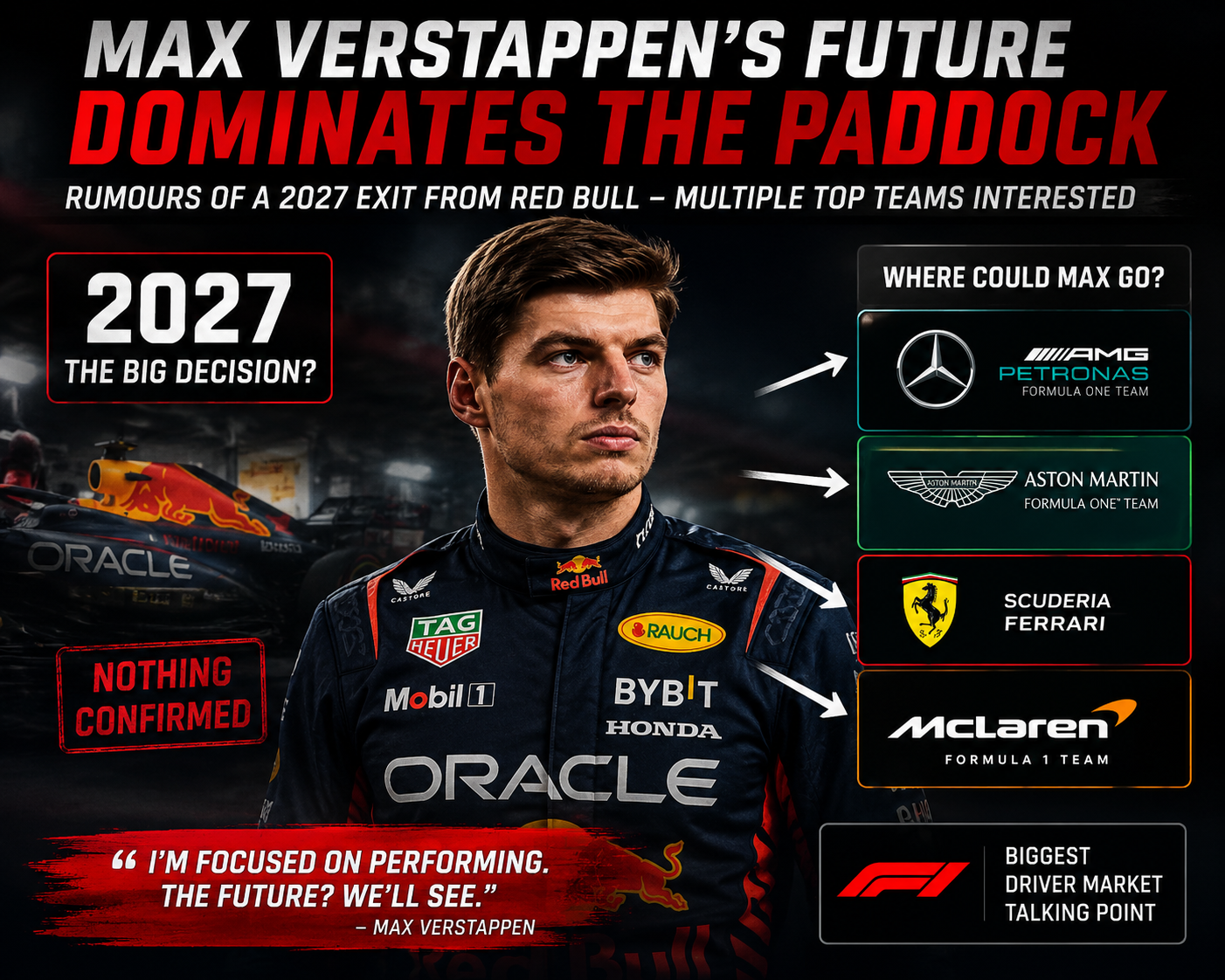
Nothing below is confirmed by Max Verstappen or Red Bull as a done deal. There has been no announcement of a departure, no signed contract with a rival team, and Red Bull has not conceded it will lose him. What is confirmed is narrower and more mechanical: a contractual clause has become mathematically active, several senior figures around Verstappen have left or are leaving the team, and rival team principals have stopped denying interest as firmly as they once did. That combination is why the paddock is treating 2027 as genuinely open, rather than the usual noise that follows every driver into a summer break.
The exit clause: what it says, and why Silverstone triggered it
Verstappen signed a contract extension with Red Bull that runs to the end of the 2028 season. Buried inside it, however, is understood to be a performance-linked exit clause: if Verstappen is not running inside the top two positions of the Drivers' Championship at the start of the summer break, he gains the right to negotiate an early release for 2027 rather than seeing out the full term. Clauses like this are common in modern F1 contracts — they protect a top driver from being trapped in a car that stops being competitive, without forcing a team to explicitly write "if we build a slow car, you can leave" into the deal.
For most of 2026 the clause was a theoretical safeguard rather than a live issue. That changed at the British Grand Prix, where Verstappen's race ended early after a suspected rear-wing failure sent him into the gravel at Stowe. The DNF was costly enough, combined with the gap already built up by Mercedes' Kimi Antonelli and George Russell at the front of the standings, that with only a couple of rounds left before the break it became a mathematical certainty Verstappen could not climb back to second or better in time. The clause did not need a further race to confirm it — the arithmetic already closed the door.
Cause one: a car that hasn't been fast or reliable enough
The clause only matters because of what's driving it: Red Bull's RB22 has struggled with both raw pace and reliability through 2026, and the team has slipped to fourth in the constructors' championship — well off the front-running pace of Mercedes and Ferrari that Verstappen had grown used to fighting for wins against. Reports describe him as "fed up" after a string of incidents, including two very similar mechanical failures in close succession. Team principal Laurent Mekies did not push back on that frustration publicly, telling reporters "he's right not to be happy" — an unusually candid concession from a team boss about his own car.
This is the throughline of almost every report on the situation: Mekies has repeatedly framed the standoff as being about performance, not politics. Verstappen wants proof the car will be competitive again before he commits further; Red Bull wants loyalty without being able to fully guarantee that competitiveness yet.
"He's right not to be happy."
— Laurent Mekies, Red Bull team principal, on Verstappen's frustration this seasonCause two: Red Bull is in the middle of a leadership and personnel reshuffle
The clause is landing at the worst possible moment for team stability. Christian Horner's departure earlier in the year left Laurent Mekies running the team, and the reshuffle hasn't stopped at the top. Paul Monaghan is reported to be on gardening leave ahead of an expected move to Cadillac's incoming F1 project, and Gianpiero Lambiase — Verstappen's race engineer and effectively his voice on the pit wall since his junior days — is reported to be leaving for McLaren at the end of the season. For a driver whose relationship with his engineer is often described as one of the tightest in the paddock, losing Lambiase specifically is being read as one of the more significant threads in this story, separate from the car's form entirely.
Put together, the picture reporters are painting is of a team trying to convince its lead driver to stay through a rebuild it can't yet prove will work, while simultaneously losing some of the senior people Verstappen trusted to help deliver that rebuild.
Red Bull's response: an offer to buy out the clause, rejected
According to reporting on the negotiations, Red Bull attempted to buy out the exit clause outright — effectively paying to remove Verstappen's contractual right to leave early. He is understood to have rejected that offer outright, which several outlets have read as a signal that he wants to keep his options open rather than pre-commit to Red Bull regardless of how 2027 turns out. That rejection, more than any single race result, is what pushed the story from "worth watching" to "tension at boiling point," in the words of one report.
So where could he go? The three names in the conversation
Mercedes was the destination most floated when speculation first began, but the more recent reporting narrows that door considerably: Mercedes is described as intending to keep its current pairing of George Russell and Kimi Antonelli, which would leave no seat open for Verstappen even if he wanted one. That leaves two names doing most of the work in current rumours.
McLaren is currently the loudest name. CEO Zak Brown has said he's had "no conversations" with Verstappen and that the team is "very happy" with Lando Norris and Oscar Piastri — but he has stopped short of ruling a move out entirely, at one point using a deliberately vague "banana peel" analogy on the topic rather than a flat denial. Adding intrigue, Piastri's own McLaren contract reportedly contains a mirror-image clause: he can activate an exit if he's outside the top five in the standings at the start of the summer break. That has fed speculation, still unconfirmed, of a possible driver swap — Verstappen to McLaren alongside Norris, Piastri going the other way to Red Bull. Some reports frame McLaren's public caution less as genuine hesitation and more as its shareholders limiting how far Brown can go publicly while talks, if they exist, stay private.
Aston Martin is the third name, mentioned by outlets including Sky Sports as a team to watch. The case for it rests less on current results and more on trajectory: Adrian Newey's arrival at the team and Lawrence Stroll's stated ambition to turn Aston Martin into a genuine championship contender make it a plausible long-term project for a driver looking past 2027 rather than just at it. It remains the most speculative of the three.
What would actually cause a "chaos" scenario
One widely quoted line from the coverage is that a Verstappen move "would cause chaos in the F1 driver market" — and that's not an exaggeration given how many contracts interlock. A Verstappen-to-McLaren swap would require Piastri to have somewhere to land, most plausibly Red Bull, which would then need to resolve what happens to its current second-seat driver. Any Verstappen move at all would trigger a scramble among the remaining teams for the highest-profile free seat in a generation, with knock-on contract negotiations across multiple grids rather than a single clean swap. That interlocking complexity is a large part of why team principals across the paddock are choosing careful, non-committal language rather than flat denials right now.
How this story has moved, timeline style
The bottom line
Nothing here is settled, and it's worth restating that plainly: Verstappen has not left Red Bull, hasn't signed anywhere else, and his current deal on paper still runs to 2028. What has changed is that the safety net protecting him from being stuck in an uncompetitive car is now confirmed live, several people he has long trusted around the garage are already heading elsewhere, and he turned down Red Bull's attempt to make the question go away. Laurent Mekies has effectively said the team knows what it needs to do — show Verstappen a car that can win consistently again. Whether Red Bull can do that before he has to make a real decision is now the single biggest subplot of the 2026 season, regardless of who wins the championship.

